Machines of Loving Grace: A Utopian Case for Artificial Intelligence
-Frederic Kwan 06/08/2026
This monologue is an attempt to imagine the utopian future artificial intelligence might deliver if it is manifested wisely; A counterpoint to the ‘doomerist’ vision of AI that has come to grip my generation, and one to which I myself am not always immune. - Frederic
A Utopian Case for Artificial Intelligence
On abundance, work and the liberation of human time.
There is an old habit in the history of technological change, mankind invents a machine capable of relieving him of some ancient burden, and immediately becomes frightened that he shall have nothing left to do.
The loom would destroy the weaver. The tractor would empty the countryside. The computer would make the clerk obsolete. Each fear contained some truth. Occupations disappeared; communities were disrupted; fortunes changed hands. Progress has never arrived politely.
And yet, viewed from the distance of centuries, another story emerges.
The history of economic development is, in considerable part, the history of mankind slowly purchasing his freedom from necessity.
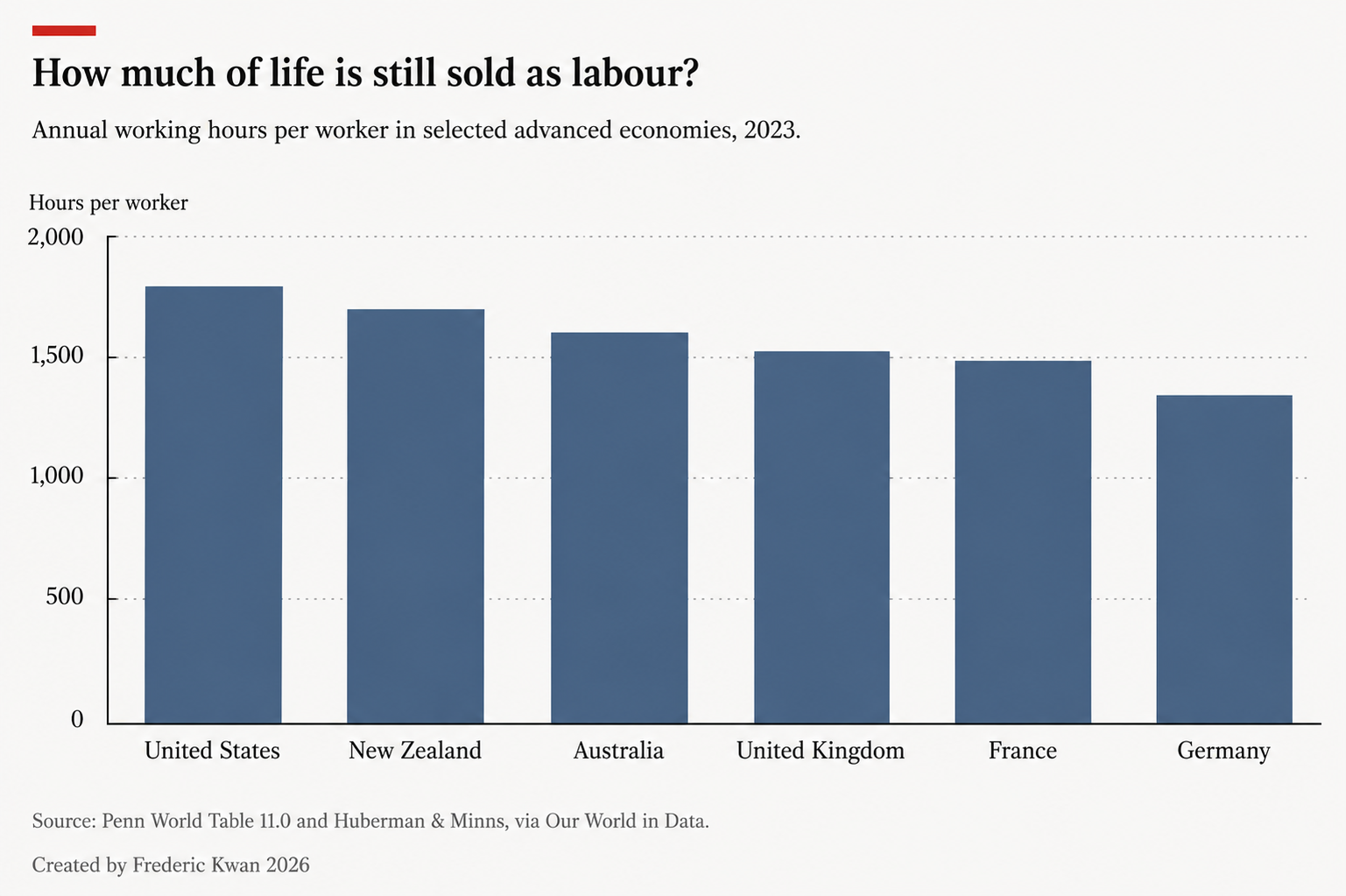
A nineteenth-century labourer in an industrial economy might work more than 3,000 hours each year. In the wealthiest modern economies, the figure is often closer to 1,500. We have not become poorer because we surrendered those hours. We became vastly richer. Productivity permitted society to obtain more output from less human time, and some portion of that dividend was eventually taken not in additional goods, but in Saturdays, holidays, retirement and evenings at home.
That may be the most important way to think about artificial intelligence.
Not as a machine which replaces man, but as a machine which may increasingly replace the burdens placed upon man.
The Ancient Bargain
Economics begins with scarcity.
There are only so many hours in a day, so many workers, so much land, so much capital. Almost every political argument eventually becomes an argument over who receives what precisely because there has never been enough of everything for everyone to have as much as they might desire.
Human civilisation has therefore been organised around labour.
For most of history, survival demanded an extraordinary quantity of it. Fields had to be cultivated, clothes stitched, accounts calculated, letters copied, cargo carried and records searched by human hands.
The industrial revolution altered that bargain. Machines substituted mechanical power for muscle; electricity separated production from daylight; computers transferred calculation from the human mind to silicon.
Artificial intelligence represents something stranger.
For the first time, automation is moving decisively into the domain of cognition.
The machine no longer merely lifts the crate. It can increasingly read the invoice, identify the crate, determine where the crate ought to go, write the instructions for moving it and optimise the system through which millions of other crates travel.
The economic implications are correspondingly larger.
The International Monetary Fund estimates that roughly 40% of global employment is exposed to artificial intelligence, rising to around 60% in advanced economies. Yet exposure does not mean extinction. In many occupations AI complements rather than replaces human labour, allowing the same worker to produce more in the same period of time.
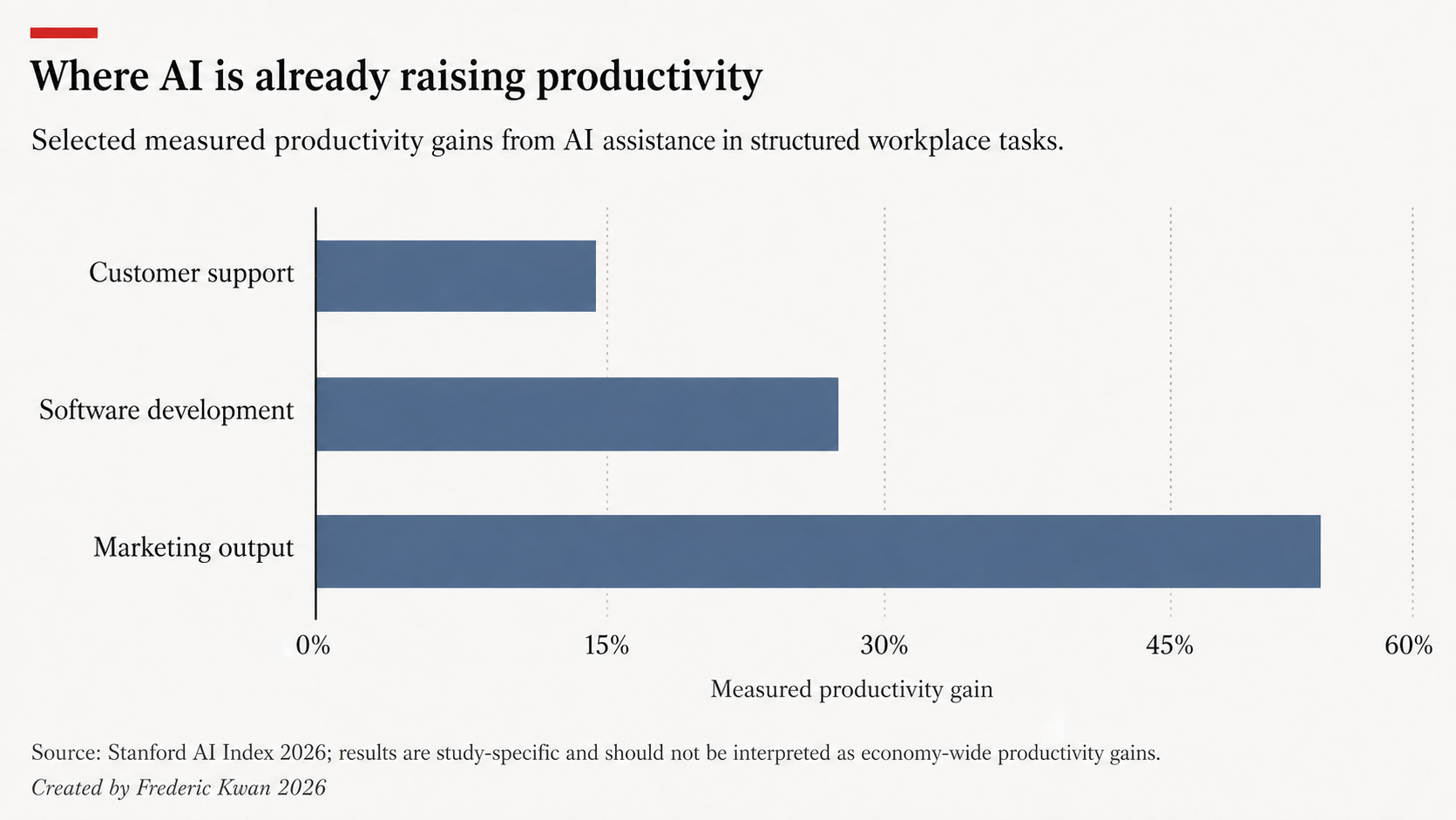
Already, controlled studies provide glimpses of this effect. Generative AI assistance increased productivity by roughly 14% among customer-support workers in one large real-world study, with considerably larger gains among less experienced employees. Other research summarised by Stanford's 2026 AI Index records substantial gains in software development and certain marketing tasks.
These numbers are early, imperfect and context-dependent. But their direction matters.
If intelligence becomes cheaper, then so does everything for which intelligence is an input.
And intelligence is an input into almost everything.
The economics of grace
Suppose that an accountant once required ten hours to perform a body of work and, assisted by sufficiently capable artificial intelligence, requires five.
There are two ways to interpret what has happened.
The first is the language of the balance sheet. Productivity has doubled. The firm can produce twice as much accounting for the same labour cost.
The second is more interesting.
Five hours of human life have been released.
Economics tends to describe technological progress in terms of output because output can be measured. But the deepest dividend of productivity is not necessarily more consumption. It is time.
Time to raise children. Time to care for ageing parents. Time to read things nobody has asked us to read. Time to paint mediocre pictures, tend unnecessary gardens, linger over lunch, learn the piano at forty-five, walk beside the sea, participate in civic life or spend an afternoon arguing about philosophy with a friend.
These activities frequently appear unproductive in national accounts.
That may be an indictment of the accounts rather than the activities.
John Maynard Keynes imagined in 1930 that technological advancement might eventually permit his grandchildren to confront an unfamiliar problem: what human beings should do with themselves once the "economic problem" had been substantially solved.
He was premature.
But he may not have been wrong.
Over the last century and a half, rising productivity has already coincided with a remarkable reduction in working time throughout rich societies. Historical data compiled by economic historians and the Penn World Table show annual hours falling dramatically across the industrialised world.
The machine has already been buying back pieces of our lives.
Artificial intelligence could accelerate the purchase.
Abundance is not the same as wealth
The more radical possibility lies beyond the office.
Artificial intelligence is sometimes discussed as though its primary purpose were writing emails more quickly. This is rather like encountering electricity in 1880 and concentrating upon its potential to improve candles.
Its greater consequences may arise where intelligence constrains the production of physical things.
Scientific discovery is one example. Artificial intelligence can search enormous spaces of possible molecules, materials and biological structures at a speed no individual laboratory could replicate. Stanford's 2026 AI Index records the growing penetration of AI into scientific research across biology, chemistry, physics and astronomy.
If AI compresses the time required to discover a drug, design a material, optimise a power grid or solve an engineering problem, then its economic contribution is not merely the salary-hours saved by a scientist. It is the value of discoveries that might otherwise have arrived years later; or never arrived at all.
Combine machine intelligence with increasingly capable robotics and the implications become still more profound.
A civilisation in which cognition is abundant and physical manipulation increasingly automated begins to approach a historically unusual condition: many goods and services can become extraordinarily inexpensive to produce.
Not infinitely abundant. Matter remains matter. Energy must be generated. Land cannot be conjured into existence.
But scarcity has degrees.
Music was once scarce because every performance required musicians. Recorded sound made a particular performance reproducible. Digital technology drove the marginal cost of copying it towards zero.
Knowledge underwent a similar transformation.
Artificial intelligence hints at the possibility that certain forms of expertise may follow.
A private tutor, translator, programmer or research assistant was once necessarily scarce because each required the exclusive attention of another human being. A sufficiently capable artificial intelligence can give millions of people access to some approximation of these services simultaneously.
The consequences for human welfare could be enormous, particularly for those who presently cannot afford expertise at all.
The Paradox of Displacement
There is, of course, a darker interpretation.
The same machine capable of liberating the worker from his labour is capable of liberating the employer from his worker.
This is not a semantic distinction to the person who has just lost his income.
The International Labour Organisation estimates that one in four workers worldwide now occupies an occupation with some degree of exposure to generative AI, although it judges transformation more likely than complete replacement for most jobs.
And there are already warning signs. Stanford's 2026 AI Index finds labour-market effects appearing disproportionately among younger workers in exposed occupations.
Any serious optimism about artificial intelligence must therefore reject one particularly lazy assumption: that technological abundance automatically becomes human abundance.
It does not.
A machine may make society immensely productive while leaving the gains concentrated among the owners of the machine.
Indeed, the central political-economic problem of an AI-rich society may eventually cease to be how to produce enough and become how to distribute what can be produced.
If labour becomes less essential to production, then an economic system in which access to consumption depends overwhelmingly upon selling one's labour begins to contain an obvious contradiction.
The answer need not be the abolition of markets. Markets remain extraordinarily powerful mechanisms for communicating preferences, organising production and rewarding innovation.
But the social contract may have to evolve.
A universal basic income, negative income tax, social dividend, broader capital ownership or some combination of these mechanisms may cease to look like charitable redistribution and begin instead to resemble the distribution of a technological dividend.
If machines participate increasingly in creating society's wealth, citizenship itself may justify some claim upon the abundance they create.
The objective should not be equality in poverty.
It should be capitalism in abundance.
What becomes of work?
There is another objection, more philosophical than economic.
Would a world requiring little work actually make us happy?
Work does more than furnish a wage. It gives routine, identity, status and the small dignity of being needed. A society that removed employment without replacing these functions could produce extraordinary material wealth alongside extraordinary spiritual poverty.
But this objection risks confusing work with purpose.
Human beings were purposeful long before the invention of the salaried office.
A mother raising her child works. A man restoring a heritage/ special character house works. A composer labouring over music nobody commissioned works. The retired scholar translating Greek or Qin Dynasty characters for pleasure works in every sense except that recognised by payroll software.
The distinction that matters is not between work and idleness.
It is between chosen exertion and compulsory toil.
Utopia was never supposed to mean lying motionless beneath a palm tree while machines feed us grapes. Human beings would become intolerable within a fortnight.
A more attractive future is one in which survival demands less of us, leaving us free to demand more of ourselves.
We might work because we wish to build, discover, compete, serve, create or excel, not merely because Thursday's rent is approaching.
That would not represent the death of ambition.
It might represent ambition finally detached from necessity.
The Pessimists Deserve a Hearing
None of this future is guaranteed.
Daron Acemoglu has cautioned against extravagant predictions of an imminent productivity explosion. His task-based estimates suggest that the aggregate productivity effects of current AI could be meaningful yet considerably smaller than the most enthusiastic forecasts imply.
He may be right.
Artificial intelligence may advance more slowly than its evangelists expect. Productivity improvements visible in laboratory studies may prove difficult to reproduce throughout whole economies. Institutions may resist change. Energy and computing infrastructure may constrain deployment. Badly designed AI may create as much useless work as it eliminates.
Nor can the dangers surrounding concentrated power, surveillance, misinformation, autonomous weapons and loss of human agency simply be waved away in the name of progress.
Utopia deserves scepticism precisely because so many horrors have been committed by men claiming to know the road towards it.
But uncertainty cuts both ways.
We should be wary of assuming catastrophe merely because catastrophe is easier to dramatise.
There is something curious about a civilisation that can imagine with extraordinary clarity how artificial intelligence might destroy it, yet struggles to imagine with equal seriousness how the same technology might make ordinary life gentler.
Prudence requires us to study the danger.
Wisdom requires us also to understand what we are trying to save the technology for.
Machines of Loving Grace
Richard Brautigan imagined a world watched over by "machines of loving grace". His poem was deliberately strange: pastoral and mechanical images interwoven until nature and technology ceased to appear enemies.
Perhaps that is the useful image.
The purpose of artificial intelligence should not be to construct a colder civilisation in which every second is measured, every worker optimised and every remaining inefficiency hunted into extinction.
It should be almost the opposite.
We should make the machines efficient so that human beings are permitted not to be.
Let machines optimise routes while we wander.
Let them remember every appointment while we occasionally forget the time.
Let them perform the calculations, reconcile the spreadsheets, search the databases, monitor the machinery and execute the innumerable small administrative rituals with which modern civilisation has cluttered human existence.
And let human beings retain those things whose value derives precisely from the fact that a human being chose to do them.
Love. Friendship. Duty. Beauty. Curiosity. Craft. Discovery. Conversation. The raising of children and the care of the old. The creation of things whose usefulness cannot easily be entered into a spreadsheet.
The utopian case for artificial intelligence is therefore not really a case for artificial intelligence at all.
It is a case for human life.
For two centuries, machines have increased the quantity of things civilisation can produce. The great promise of the next machine age is that, if we are wise enough to distribute its fruits, it might at last increase the quantity of life we are free to live.
Perhaps abundance is not a world in which man possesses everything.
Perhaps it is simply a world in which so much of what once compelled him has fallen away that, for the first time, he possesses himself.
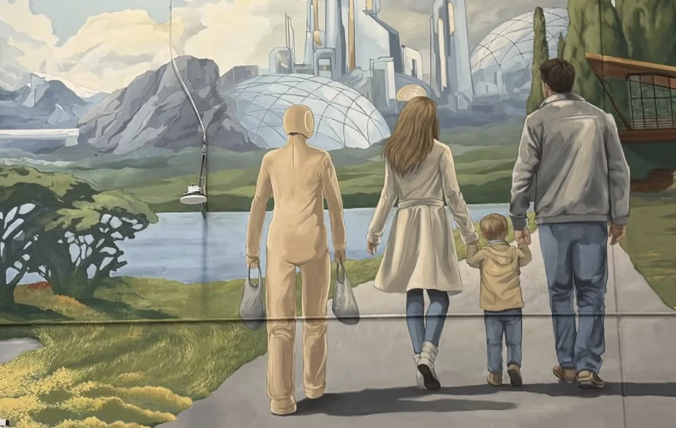
Overlooking the 1X Technologies factory floor where thousands of pre-ordered NEO robots are being manufactured, this mural imagines a future soon to arrive, in which man and machine walk together into a more abundant world. Source: 1X Technologies.